
Table of Contents
A good travel essentials bag isn’t about cramming in everything you might need. It’s about carrying exactly what you’ll use, nothing you won’t, and knowing where every item lives before you zip it shut.
Whether you’re packing a weekend duffel or a week-long carry-on, the same core list applies. Below is a complete, trip-tested breakdown of what belongs in your travel essentials bag, how to organize it, and how to adjust it based on trip length, destination, and traveler.
What Is a Travel Essentials Bag?
A travel essentials bag is the core set of items — documents, tech, clothing, toiletries, and safety gear — that goes on every trip regardless of destination or length. Think of it as your packing foundation. You add trip-specific items on top, but the base list rarely changes.
This matters because most overpacking happens when travelers pack from scratch every time, second-guessing what they need instead of working from a proven system. A defined essentials list removes the guesswork.
For example, a business traveler heading to Chicago for two nights and a backpacker heading to Vietnam for a month both need a phone charger, a copy of their passport, and a small medical kit. The essentials bag is the same starting point — only the volume and trip-specific extras change.
Travel Essentials Bag vs. a Generic Packing List
The two terms get used interchangeably, but they’re not quite the same thing. A packing list is trip-specific — it might include a snorkel for a beach trip or hiking boots for a mountain trip. A travel essentials bag is the reusable core underneath every one of those lists.
Think of it in layers. The essentials bag is layer one: documents, tech, toiletries, a medical kit, and versatile clothing. Layer two is destination-specific gear. Layer three is trip-length adjustments — more clothing for two weeks, less for a long weekend. Building your packing process this way means you’re never starting from a blank page, and you’re not relying on memory the night before a flight, when items are most likely to get forgotten.
For more on how baggage allowances affect what you can bring, check your airline’s carry-on and checked baggage policy page directly — allowances change often and vary by fare class, so a general guide (including this one) should be treated as a starting point, not the final word.
The Smart Packing Philosophy
Packing light isn’t a minimalist trend — it’s a functional strategy. Fewer items mean faster movement through airports, less risk of lost luggage, and more mental bandwidth for the actual trip.
Two frameworks make this concrete:
The 5-4-3-2-1 packing method — five tops, four bottoms, three pairs of shoes (worn plus two packed), two accessories or dressy items, one swimsuit. It caps clothing volume without leaving gaps.
The capsule wardrobe approach — choose one color palette so every top pairs with every bottom. A traveler packing navy, white, and denim can create a dozen outfit combinations from six garments.
Both methods rely on versatile clothing: t-shirts, jeans, and shorts that mix and match rather than single-use outfits. A cocktail dress worn once isn’t a packing essential — a blazer that dresses up three different outfits is.
There’s a simple test for whether an item belongs in your travel essentials bag: can you picture at least two separate situations on the trip where you’d actually use it? If the honest answer is no, it stays home. This test alone eliminates most of the “just in case” items that quietly fill a suitcase — the extra pair of dress shoes, the third jacket, the gadget you’ve never used at home either.
Packing light also has a practical upside beyond convenience. Airlines increasingly charge for checked bags, and many budget carriers now charge for anything beyond a small personal item. A traveler who can consistently fit a week’s trip into a carry-on isn’t just moving faster through the airport — they’re often saving $60 to $120 per flight in bag fees, money that goes further spent on the actual trip.
Core Travel Essentials Checklist
This is the heart of any travel essentials bag. Break it into five categories so nothing gets missed during packing.
Documents, Money, and Valuables
- Valid passport (and visa, if required)
- A physical and digital copy of important documents
- Travel insurance documentation
- Vaccination documentation, if your destination requires it
- Cash in local currency, plus a backup card
- RFID wallet to block electronic pickpocketing
- Money belt or theft-resistant, waterproof bag for high-risk destinations
- Jewelry and valuables case for anything you can’t leave behind
Worked example: A traveler heading to Southeast Asia photographs their passport, visa, and insurance policy, then emails the images to themselves and stores them in a password-protected cloud folder. When their wallet is pickpocketed in Bangkok, they replace their card same-day using the backup copy instead of losing a full travel day at an embassy.
Tech and Gear
- Laptop and charger
- Smartphone and charger
- eSIM or international phone plan / local SIM card
- Universal power adapter and voltage converter
- External battery or portable charger
- Bluetooth wireless adapter
- Wired earbuds or headphones (a backup that never needs charging)
- Camera, if you shoot beyond your phone
- Tech organizer to keep cables from tangling in your bag
A universal power adapter is one of the most commonly forgotten items on this list, mostly because travelers assume their charger will “just work” abroad. Outlet shape is only half the issue — voltage differs by region too, and plugging a device built for 120V into a 220V outlet without a converter can damage it. Check your destination’s voltage before you pack, not after you land.
Clothing
- Versatile t-shirts, jeans, and shorts
- Underwear and socks (pack one extra pair of each beyond your trip length)
- A change of clothing kept accessible in your carry-on, in case checked luggage is delayed
- Bathing suit and flip-flops
- Sneakers and one pair of dress shoes
- A light jacket for temperature swings
- Polarized sunglasses
Toiletries and Small Medical Kit
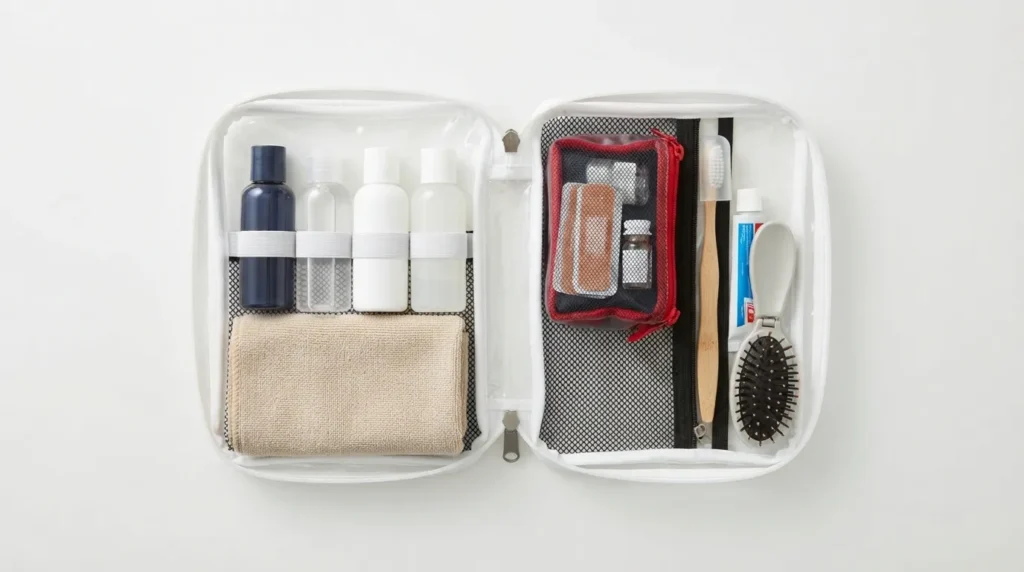
- Toothbrush, toothpaste, and floss
- Deodorant, razor, shampoo, and shower gel in travel-sized containers
- Refillable travel capsules to avoid buying minis every trip
- A toiletry bag with wet and dry compartments
- Travel towel (quick-dry, packs flat)
- Hand sanitizer
- Prescription medications in original packaging
- A small medical kit: band-aids, hydrocortisone cream, antibacterial cream, eye drops, and Tylenol
Worked example: A traveler with a nut allergy packs antihistamines and a printed allergy card in the destination language inside their small medical kit. When a restaurant mislabels a dish abroad, the card communicates the allergy instantly — no translation app needed.
Comfort and Entertainment
- Kindle or e-reader
- Eye mask for flights
- Snacks for layovers and delays
- A reusable water bottle
- Entertainment for long flights (downloaded shows, a book, or a travel game)
- Activities or games for group trips
If you’re flying six hours or more, it’s worth building a dedicated in-flight kit — see our long-haul flight essentials guide for what to add on top of the basics above.
How to Pack a Suitcase (Without Hating It)
Packing method matters as much as the packing list. Follow this order to avoid wrinkled clothes and wasted space:
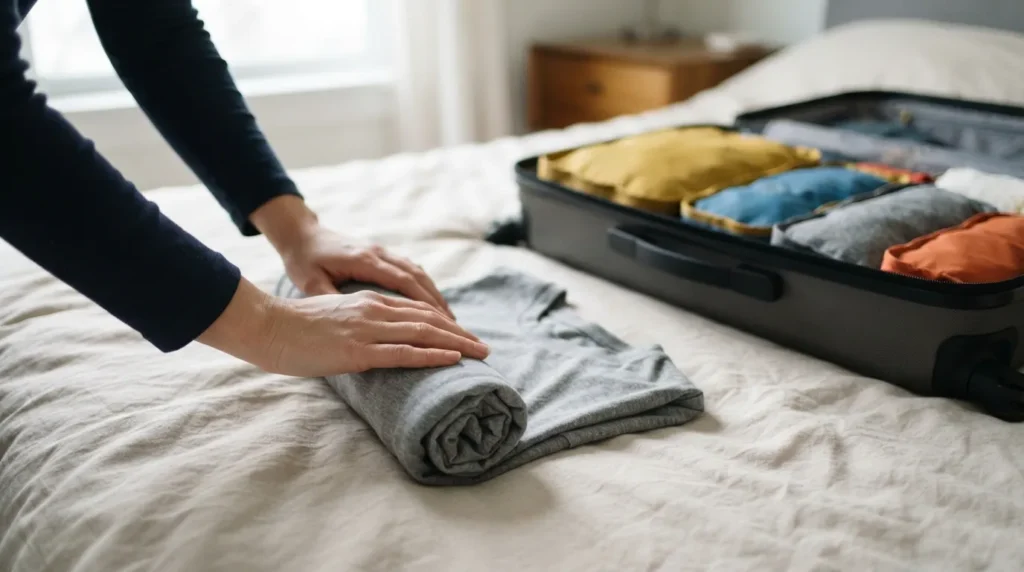
- Layer heaviest items at the bottom, closest to the wheels — shoes, toiletry bag, tech organizer.
- Roll, don’t fold, soft clothing. Rolled t-shirts and jeans take up less space and wrinkle less than folded stacks.
- Use packing cubes to separate categories — one for tops, one for bottoms, one for underwear and socks. This turns a jumbled suitcase into a drawer system.
- Fill dead space with socks stuffed inside shoes and a small backpack strategy for anything you’ll want mid-flight.
- Keep a mini clip bag for small loose items — chargers, earbuds, hand sanitizer — clipped to the outside of a packing cube so they don’t get buried.
- Secure the bag with a combination lock if checking luggage.
Worked example: A traveler packing a 22-inch carry-on for a 10-day trip uses three packing cubes (tops, bottoms, underwear) plus a compression cube for the toiletry bag. The result: a suitcase that’s still half-full after packing, leaving room for souvenirs on the way home.
Travel Essentials Bag Checklists by Trip Length
Trip length changes volume, not the core list. Use these two formulas as a baseline.
The 3-Day Minimalist Formula
Built for a personal item or small backpack only:
- 2 tops, 1 bottom, 1 pair of extra underwear and socks per day
- 1 pair of shoes worn, 1 packed
- Toiletry bag with 3-1-1 liquids rule containers
- Phone, charger, portable charger
- Wallet, ID, cash
The Week-Long Trip Packing List
Built for a standard carry-on:
- 5-4-3-2-1 method clothing count
- Full toiletry bag with refillable capsules
- Small medical kit
- Laptop and tech organizer
- One change of clothing kept in the personal item, separate from checked or overhead luggage
| Trip Length | Bag Size | Clothing Volume | Toiletries | Tech |
|---|---|---|---|---|
| 3-Day Minimalist | Personal item / small backpack | 2 tops, 1 bottom | 3-1-1 liquids only | Phone + charger |
| Week-Long | Carry-on (22″) | 5-4-3-2-1 method | Full toiletry bag | Laptop + tech organizer |
| International (2+ weeks) | Carry-on + personal item | Capsule wardrobe | Refillable capsules + meds | Universal adapter + eSIM |
International Travel Essentials and Documentation
International trips add a documentation layer that domestic trips skip. Build this into your travel essentials bag well before departure:
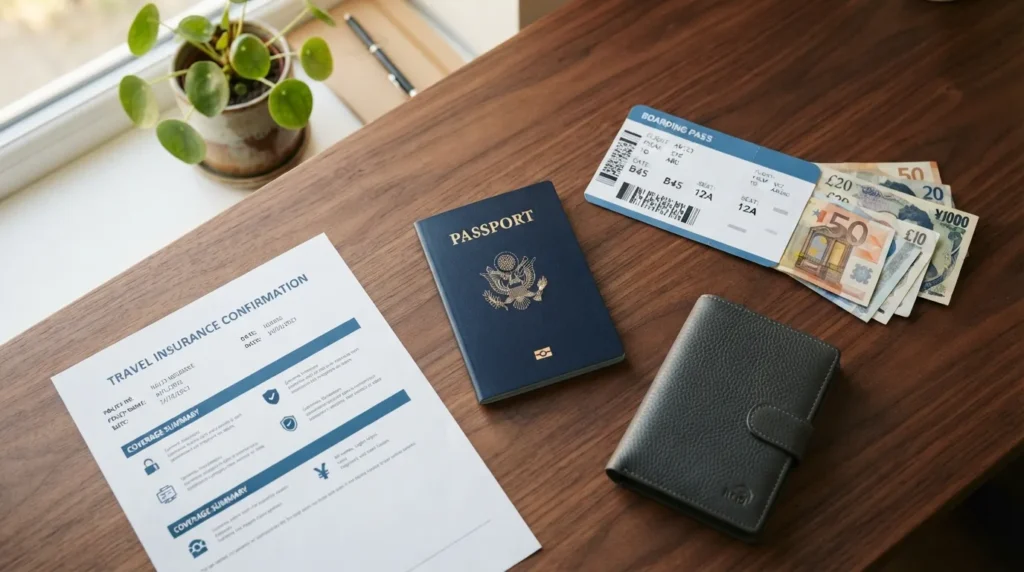
- Valid passport with at least six months of validity remaining (check requirements at travel.state.gov)
- Visa, if required for your destination
- Travel insurance documentation, printed and digital
- Vaccination documentation for destinations that require it
- A completed CBP Declaration Form for re-entry, if traveling to the U.S.
- International phone plan or local SIM/eSIM
- Voltage converters matched to your destination’s outlets
- Awareness of local cultural dress codes, especially for religious sites
Worked example: A traveler visiting Southeast Asian temples packs a lightweight scarf and long pants specifically to meet cultural dress codes requiring covered shoulders and knees — items that wouldn’t make a domestic packing list but are non-negotiable abroad.
Carry-On Rules and TSA Requirements
Carry-on rules are where most packing mistakes happen. Know these before you pack, not at security.
- 3-1-1 liquids rule: containers of 3.4 oz (100ml) or less, in one quart-sized clear bag, one bag per traveler
- TSA prohibited items list: check the official TSA prohibited items list before packing anything sharp, flammable, or pressurized
- Carry-on dimensions: typically 22 x 14 x 9 inches, though this varies by airline — always confirm before flying
- IATA baggage weight regulation: international carriers often enforce carry-on weight limits (commonly 15-22 lbs) that U.S. domestic carriers don’t
Pack ziplock bags for liquids beyond your quart bag that you plan to check, and keep prescription medications in original, labeled packaging to avoid delays at security.
Female Travel Essentials Bag: What to Add
A female travel packing list overlaps heavily with the core essentials bag, with a few additions worth planning for:
- Extra hygiene products, sized for trip length plus a buffer
- A jewelry and valuables case that separates delicate pieces from clothing
- A crossbody or theft-resistant personal item (purse, tote, or backpack) for daily use separate from the main bag
- Makeup organized in refillable travel capsules to cut weight and space
Worked example: A traveler swaps a bulky makeup bag for three refillable silicone capsules holding foundation, moisturizer, and sunscreen — cutting toiletry bag volume by nearly half without leaving anything behind.
For a full category-by-category breakdown, see our dedicated travel essentials for women guide.
Packing Tips to Travel Lighter
- Lay everything out before packing, then remove one-third of it
- Wear your bulkiest item (jacket, sneakers) on travel days instead of packing it
- Choose a small backpack strategy for your personal item so it fits under the seat and doubles as a day bag
- Reuse the same capsule wardrobe colors across multiple trips so you’re not rebuying travel clothing
- Keep a standing packing list saved on your phone and update it after every trip based on what you didn’t use
- Pack a spare set of ziplock bags — they double as leak protection for toiletries, a wet-clothing bag, and a snack container
- Weigh your bag at home before you leave if you’re checking it; a bathroom scale under the handle gets close enough to avoid a surprise fee at check-in
- Give every item a “home” inside the bag (same pocket, same cube) so packing and unpacking take minutes instead of a full search each time
If you want a deeper look at how weight allowances differ between airlines, IATA’s published baggage guidance is a useful external reference point before an international trip — domestic carry-on rules and international carry-on rules aren’t always the same, and IATA’s weight recommendations are stricter than what many U.S. domestic carriers enforce.
FAQ
What are the must-have items in a travel essentials bag?
Documents (passport, insurance, copies), a phone charger, prescription medications, versatile clothing, a small medical kit, and toiletries in travel-sized containers cover nearly every trip.
What is not allowed in a carry-on bag?
Sharp objects, most flammable items, and liquids over 3.4 oz outside the 3-1-1 quart bag are restricted. Always check the current TSA prohibited items list before flying.
How do I pack for a week-long trip in a carry-on?
Use the 5-4-3-2-1 method for clothing, pack toiletries in refillable travel capsules, and use packing cubes to keep everything organized in a single 22-inch bag.
What should I pack for a 3-day trip?
Two tops, one bottom, one extra set of underwear and socks per day, a small toiletry bag following the 3-1-1 rule, and a phone charger — all fitting in a personal item or small backpack.
Do I need travel insurance documentation for every international trip?
It’s not always legally required, but it’s strongly recommended. Some destinations do mandate proof of insurance for entry, so check requirements before you travel.
What’s the difference between a personal item and a carry-on?
A personal item (purse, tote, or small backpack) fits under the seat in front of you. A carry-on fits in the overhead bin and is typically limited to around 22 x 14 x 9 inches, depending on the airline.
How many outfits should I actually pack?
For most trips, five tops, four bottoms, and one extra pair of shoes covers a week or more when combined with laundry access or a capsule wardrobe strategy. Longer trips add laundry days, not more clothing volume.
Should I pack a water filter or purification tool?
For international trips to regions where tap water isn’t reliably safe, a compact water filter like a LifeStraw is worth the space — it’s lighter than carrying bottled water and cuts down on plastic waste.
Final Thoughts
A travel essentials bag isn’t built the night before a flight — it’s built once, refined after every trip, and reused as a system rather than reinvented each time. Start with the core checklist, adjust for trip length and destination, and pack a little lighter than feels comfortable. You’ll use less than you think.